

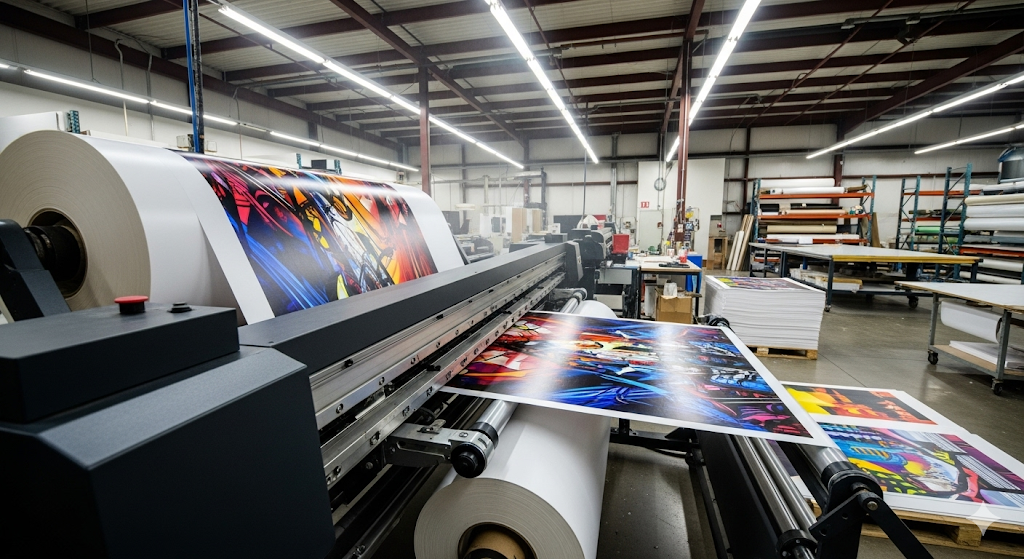

Professional printing providers offer services to a wide range of clients, including businesses in the arts, fashion, and dining industries. These companies often use advanced machines that provide durable, aesthetic results. This equipment supports uniform materials, which create similar products for large banners and business cards. Here are a few signs that you need professional printing services:
1. Managing Multi-Format Print Projects
A single campaign produces several printed items such as booklets, brochures, and inserts. Each piece may contain different content, but they share the same visual style, so the materials look consistent. Large print runs often involve a printing professional who manages the full production.
Different print formats require different setups. A booklet uses pages in order and is bound together; a brochure is folded. Posters are printed in larger sizes and need different scaling. Printing staff members are able to review these requirements before production starts, so each item is set up correctly. A printing professional often handles all items in one order. This keeps the process organized when multiple formats are involved. One order can cover all materials, even when they differ in size and structure. As the number of items increases, a single coordinated process keeps the final output aligned across the whole set.
2. Producing Large-Format Print Materials
Businesses use large-format printing when standard document sizes no longer meet display needs. Window graphics and wall visuals support storefront visibility and interior branding, while posters and banners extend messaging across larger surfaces. These formats go beyond common office paper sizes, and standard in-house printers do not produce output at that scale or with the same control over detail when coverage or dimensions increase.
Large-format printing applies to materials placed in fixed locations for ongoing visibility. Wall graphics often stay in place for long periods, while window displays present information to people outside a building. Floor decals direct movement in retail spaces, trade shows, and event areas; signage systems support navigation in larger environments. Outdoor banners communicate across distance and use materials built for exposure to weather and light.
Projects often involve custom sizing tied to physical environments. Graphics follow wall sections, doorways, columns, or window frames. Some installations require multiple panels that align into a continuous image, while others involve precise scaling to match architectural measurements. These requirements move beyond simple file resizing and involve preparation that matches the dimensions and structure of the final location.
3. Converting Digital Files for Print
Print production begins with digital files prepared for physical output. These files are created in design software and arranged in layouts suited for printing. A design may look complete on screen, yet it often requires adjustments before it moves into production. These adjustments align digital layouts with the technical limits of print equipment, paper sizes, and finishing processes. Printing companies often review files with you before production starts and discuss details such as image resolution, layout structure, and formatting so the output matches the intended result.
Specialized printing becomes relevant when digital files do not perform well on basic office equipment. Images may blur when enlarged, sizes shift across different formats, or layouts do not transfer cleanly between products. In certain cases, a single project includes multiple printed items with different dimensions; this exceeds what standard in-house printers are able to handle. Professional printing services handle these variations by producing each item according to its required format, while keeping output aligned across the full set of materials.
4. Matching the Design With the Brand
A key part of brand alignment involves selecting a physical medium that carries a company’s identity and message. Printing professionals provide design guidance and troubleshooting that help define sizes and materials for each project. They work with materials such as cardstock, paper, vinyl, and canvas. This selection process connects design choices with how the final printed items appear and function in real settings.
Hire Professional Printing Services
Businesses often create printed materials for uses that extend beyond a single purpose. You can create items for client meetings, presentations, and event distribution. Professionals produce materials for specific uses, including distribution at events, display in physical spaces, and inclusion in printed information sets. Contact a professional printing services provider today to explore your options.