


For centuries, manufacturing relied on a simple, subtractive philosophy: take a large block of raw material and cut, carve, or drill away the excess until you are left with the desired shape. While this method built the modern world, it inherently involves immense material waste, high tooling costs, and severe geometric limitations. The birth of additive manufacturing has fundamentally turned this ancient philosophy on its head.
also read: https://soutaipassu.com/
Popularly known as 3D printing, this revolutionary technology constructs physical objects layer by layer directly from a digital blueprint. What began in the late 20th century as a highly specialized tool for industrial prototyping has matured into a mainstream, disruptive force. Today, it impacts everything from local hobbyist workshops to global aerospace supply chains, rewriting the rules of production, customization, and design freedom.
What is 3D Printing? Understanding the Core Mechanics
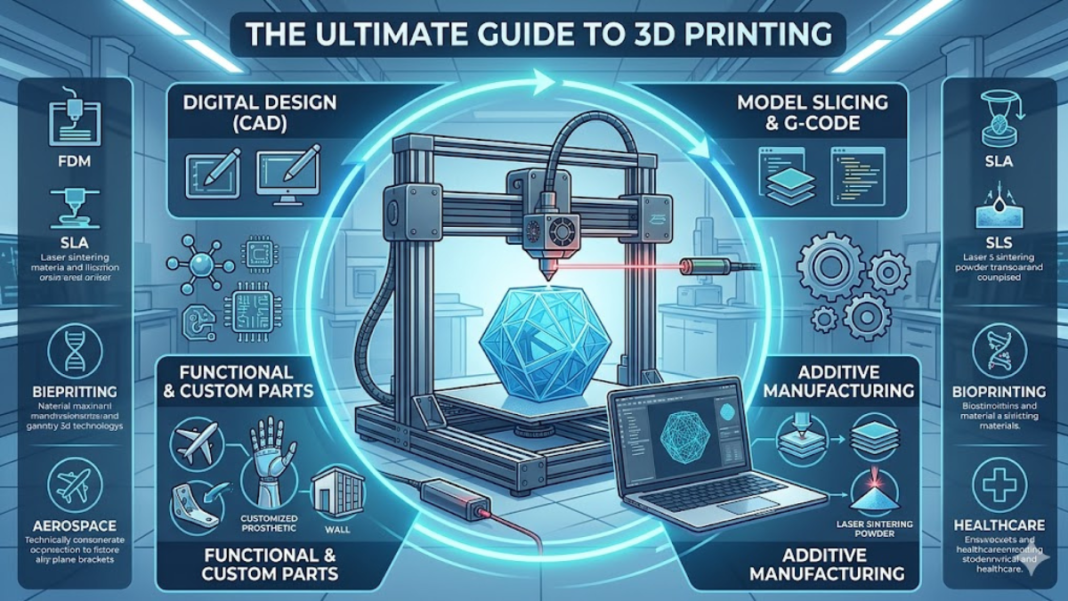
To truly appreciate the impact of this technology, it helps to understand how a digital thought transforms into a solid, tangible object. Every single print job, regardless of whether it uses plastic, metal, or biological cells, relies on a seamless bridge between software and hardware.
The journey begins with Computer-Aided Design (CAD) software or a 3D scanner. Designers create a highly detailed, three-dimensional digital model of their intended object. Once the digital model is finalized, it is exported into a standardized file format, most commonly an STL or OBJ file.
From there, a specialized piece of software called a “slicer” takes over the process. The slicer acts as the translator between the digital model and the physical printer. It cuts the virtual 3D object into hundreds or thousands of ultra-thin, horizontal, two-dimensional layers. The software then generates a specific set of geometric instructions, known as G-code, which tells the printer precisely where to move, how fast to travel, and exactly how much material to deposit on each individual layer.
The Diverse Ecosystem of 3D Printing Technologies
The term “3D printing” does not refer to a single, solitary process. Instead, it serves as an umbrella term for a highly diverse ecosystem of distinct manufacturing techniques. While they all build objects layer by layer, they differ dramatically in the types of materials they use and the physical methods they deploy to bind those materials together.
1. Fused Deposition Modeling (FDM)
Fused Deposition Modeling is by far the most widely recognizable and accessible form of additive manufacturing on the planet. It is the technology found in almost all desktop home printers and school classrooms. FDM works by feeding a solid spool of thermoplastic filament into a heated extruder nozzle.
The printer melts the plastic and precisely deposits it along a predetermined path onto a build platform. As soon as the plastic leaves the nozzle, it cools and solidifies, bonding instantly to the layer beneath it. The build platform then drops down by a fraction of a millimeter, and the nozzle deposits the next layer. Common materials used in FDM include:
- PLA (Polylactic Acid): A biodegradable plastic derived from cornstarch, loved for its ease of use and minimal warping.
- ABS (Acrylonitrile Butadiene Styrene): A tough, impact-resistant petroleum-based plastic used to make durable everyday items like LEGO bricks.
- PETG (Polyethylene Terephthalate Glycol): A highly resilient, chemical-resistant material that perfectly bridges the gap between the ease of PLA and the strength of ABS.
2. Stereolithography (SLA) and Digital Light Processing (DPL)
While FDM relies on melting solid plastics, vat photopolymerization techniques like SLA and DLP utilize liquid chemistry to achieve breathtaking levels of detail. These printers feature a vat filled with a specialized, light-sensitive liquid photopolymer resin.
An ultraviolet (UV) laser beam or a digital projector flash is directed across the bottom of the resin vat, precisely curing and hardening the liquid resin layer by layer. Because lasers can achieve incredibly fine microscopic focuses, SLA printing yields exceptionally smooth surface finishes, virtually invisible layer lines, and unmatched geometric precision. It is the go-to choice for jewelry makers, dental professionals creating crowns, and miniature model collectors.
3. Selective Laser Sintering (SLS)
Moving into high-end industrial manufacturing, Selective Laser Sintering shifts away from filaments and liquids, opting instead for fine powdered materials. Inside an SLS machine, a heavy-duty roller spreads an ultra-thin, perfectly even layer of powder across a heated build chamber.
A high-powered carbon dioxide laser then traces the cross-section of the object onto the powder bed, heating the microscopic particles just enough to fuse them together without completely melting them—a process known as sintering. Once a layer is complete, the powder bed drops, a fresh layer of powder is swept over the top, and the laser fires again.
A major mechanical benefit of SLS is that the unsintered powder remaining in the bed acts as a natural, built-in structural support system for the object as it is being built. This allows engineers to print incredibly complex, interlocking, and hollow geometries that would be completely impossible to fabricate using any other manufacturing method.
| 3D Printing Technology | Primary Material Used | Standout Advantage | Common Practical Use Case |
| FDM (Fused Deposition) | Thermoplastic filaments (PLA, ABS) | High affordability and ease of use. | Rapid concept modeling, educational projects. |
| SLA (Stereolithography) | Liquid photopolymer resins | Incredible fine detail and glass-like finishes. | Dental molds, highly intricate jewelry design. |
| SLS (Laser Sintering) | Industrial nylon and polymer powders | High structural strength; needs zero support structures. | Functional mechanical testing, end-use parts. |
| DMLS (Direct Metal) | Fine titanium, steel, or aluminum powders | Unmatched durability, replaces heavy cast metals. | Aerospace brackets, custom medical implants. |
Disrupting the Global Industrial Landscape
The mainstream integration of additive manufacturing is no longer a futuristic prediction; it is actively re-engineering the economics of major global industries right now. By eliminating the need for expensive fixed molds and massive factory retooling, companies can embrace radical agility.
Aerospace and Automotive Innovation
In fields where every single gram of weight directly translates to fuel consumption and environmental emissions, additive manufacturing is a literal lifesaver. Aerospace engineers use advanced 3D printers to create lightweight, hollow components using specialized titanium alloys.
By utilizing computer-guided AI algorithms, printers can produce organic, web-like structures that maintain absolute mechanical integrity while reducing a part’s total weight by up to 40%. Furthermore, it allows for “part consolidation”—taking an assembly that previously required bolting together dozens of individual machined parts and printing it as a single, seamless, unified component.
Revolutionary Strides in Healthcare
Perhaps the most profoundly human application of this technology is unfolding within medicine. Because every human body is structurally unique, traditional mass-produced medical equipment often requires uncomfortable compromises.
Using precise data collected from CT and MRI scans, biomedical engineers can print custom-fit cranial plates, spinal cages, and prosthetic limbs tailored perfectly to a patient’s specific anatomy. Beyond hardware, scientists are making incredible headways in bioprinting, using specialized “bio-inks” comprised of living human cells to carefully construct functional tissue structures, blood vessels, and even miniature organ models for advanced pharmaceutical testing.
Frequently Asked Questions
- How long does it typically take to 3D print a single object?Print times vary drastically based on the object’s size, layer height resolution, and technology used. A small plastic keychain might take 20 minutes on a basic FDM printer, whereas a highly detailed, complex industrial component or a large architectural model can easily take 24 to 48 hours of continuous printing.
- Is 3D printing an environmentally friendly manufacturing method?Generally, yes. It is inherently less wasteful than subtractive manufacturing because it only uses the exact amount of material required to build the part. Furthermore, many common filaments like PLA are plant-based and biodegradable, and modern printers allow for the recycling of plastic scraps and unsintered industrial powders.
- What are “support structures” and why are they necessary?Because printers build objects layer by layer in mid-air, a printer cannot deposit material onto nothingness. If a design features a dramatic overhang or a bridge, the slicer software generates temporary, easily removable “support pillars” underneath those sections to hold the molten plastic or resin in place until it cures.
- Can you 3D print functional electronics?Yes. Specialized multi-material printers can co-extrude standard structural plastics alongside highly conductive silver or copper-loaded inks. This allows manufacturers to print structural parts with embedded electrical circuits, antennas, and sensor pathways directly inside the object.
- What is “4D printing”?4D printing takes standard additive manufacturing a step further by utilizing smart, programmable materials. When these printed objects are exposed to a specific external trigger—such as heat, water, electricity, or light—they can autonomously change their shape, texture, or physical properties over time.
- Can a 3D printer fabricate objects made out of food?Absolutely. Food-safe printers use specialized syringe extruders to precisely layer pureed ingredients. This technology is actively used by high-end pastry chefs to create intricate chocolate designs, sugar sculptures, and personalized nutritional meals for medical patients.
- What is the structural strength of a 3D-printed part compared to an injection-molded part?Generally, FDM parts are weaker than injection-molded parts because they are anisotropic, meaning they are weaker along the vertical axis where the layers bond together. However, industrial methods like SLS and metal printing produce parts that closely match or exceed the strength of traditionally manufactured components.
- What are the structural limitations of desktop 3D printers?The primary limitations are the physical size of the build volume, the visible layer lines that often require manual sanding or chemical smoothing, and the inability of basic machines to easily handle highly flexible or temperature-resistant engineering plastics.
- Can you use 3D printing to build a residential house?Yes. Large-scale construction printers utilize massive gantry systems or robotic arms to extrude a specialized, fast-setting concrete mixture. These machines can build the structural walls of a complete residential home in under 48 hours, radically lowering labor costs and material waste.
- What is post-processing in the context of additive manufacturing?Post-processing refers to any work done to an object after it comes off the print bed. This includes washing away uncured resin, removing temporary support structures, heat treating or baking metal parts to increase strength, sanding, priming, and painting for a beautiful retail finish.
Conclusion
The rise of 3D printing represents a historic paradigm shift in human engineering. By transforming manufacturing from a complex, subtractive physical labor into a direct digital translation, it has leveled the playing field for global innovation. From reducing industrial material waste and streamlining complex aerospace supply chains to creating life-saving custom medical implants, additive manufacturing is stepping up to solve the world’s most intricate logistical challenges. As material sciences advance and printing speeds accelerate, this technology will continue to move production out of distant centralized factories and put the power of creation directly into the hands of designers worldwide.