


In the vast spectrum of colors that the human eye can perceive, there is one particular hue that sits perfectly on the boundary between the tranquility of blue and the vibrant energy of green. This color, widely known in technical circles and design as cyanová, is far more than just a simple shade of light blue. It is a fundamental pillar of modern printing, a staple of digital interface design, and a mesmerizing element found in the purest corners of our natural world. In this detailed exploration, we will dive deep into the world of this color, examining its scientific foundations, its psychological impact, and its practical applications in our daily lives.
What Exactly is the Color Known as Cyanová?
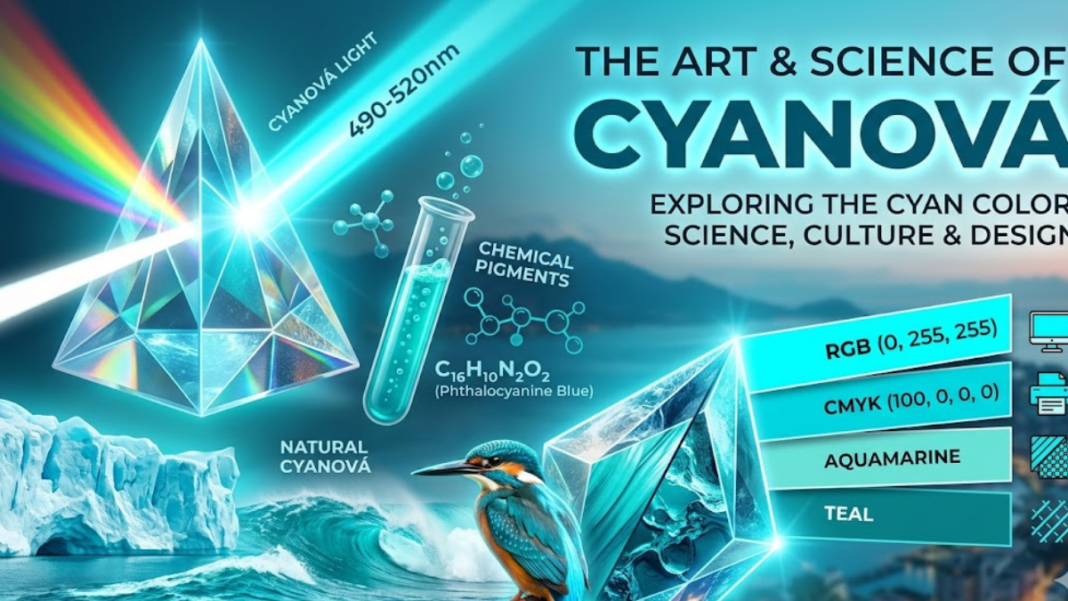
To truly understand what cyanová represents, we must first look at the visible light spectrum. From a physics perspective, cyanová (often referred to as aqua or bright azure in casual conversation, though technical differences exist) is the color perceived when light has a wavelength between approximately 490 and 520 nanometers. It is the specific sensation our eyes record when blue and green light are mixed in equal measure.
In everyday life, people often confuse it with turquoise or sky blue. However, in the realms of physics and professional design, it occupies a very specific and irreplaceable position. While standard blue can feel deep, heavy, or cold, cyanová carries a sense of “electric” energy and brightness. This unique vibrancy makes it one of the most prominent and effective colors in modern visual communication.
Technical Specifications of Cyanová
For graphic designers, web developers, and printing professionals, precision is everything. To ensure that cyanová appears consistently across various devices and materials, we use specific numerical values. Below is a breakdown of the most important technical parameters for this color:
| Format | Value | Description |
|---|---|---|
| HEX Code | #00FFFF | The standard web format for pure cyan light. |
| RGB Model | (0, 255, 255) | Full green and blue light, zero red light. |
| CMYK Model | (100, 0, 0, 0) | The primary ink used in professional printing. |
| HSL Model | 180°, 100%, 50% | Defined by a perfect 180-degree hue on the color wheel. |
The Science of Color: Cyanová in RGB and CMYK Systems
When studying how colors work, we distinguish between two main models: the additive (light-based) and the subtractive (pigment-based) models. In both of these systems, cyanová plays a pivotal role, albeit in different ways.
The Additive Model (RGB)
In the RGB system—the technology used by your computer monitor, television, and smartphone—colors are created by mixing light. In this context, cyanová is a secondary color. It is produced the moment your screen activates the green and blue sub-pixels at maximum intensity while keeping the red sub-pixel completely dark. This is why digital cyanová looks so radiant and glowing; it is literally a product of pure light radiation.
The Subtractive Model (CMYK)
In the world of physical printing, the situation is reversed. Here, cyanová is one of the four “process” colors (alongside magenta, yellow, and black). It is a primary color in this system, meaning it cannot be created by mixing other inks. Instead, it is the base color used to create all other shades of blue and green on paper. Without high-quality cyanová ink, modern full-color printing would be physically impossible.
Cyanová in the Natural World: From Deep Oceans to Rare Gems
While we might associate this bright hue with high-tech screens today, cyanová is deeply rooted in the natural world. Its presence in nature is often tied to the way light scatters and reflects off pure substances.
- Glaciers and Pure Ice: Have you ever noticed the deep, glowing cracks in ancient glaciers? This occurs because dense ice absorbs the red part of the light spectrum, reflecting only the wavelengths we perceive as cyanová.
- Tropical Waters: The “postcard-perfect” waters of the Caribbean or the Maldives owe their color to a combination of water clarity, white sand on the seabed, and the specific scattering of sunlight. This natural cyanová immediately triggers feelings of relaxation and a desire for exploration.
- Biological Wonders: Many birds, such as the kingfisher, and various tropical butterflies exhibit this color. Interestingly, this is often “structural color” rather than a pigment. Microscopic structures on their feathers or scales reflect light so perfectly that they produce a dazzling cyanová shimmer.
Color Psychology: What Does Cyanová Say About Us?
Colors have a profound ability to influence our moods and subconscious thoughts. Color psychology places cyanová among those shades that promote mental clarity and improved concentration. While dark blue might feel too serious or even somber, cyanová retains a sense of lightness and optimism.
- Tranquility and Balance: It helps reduce stress and induces a feeling of psychological safety.
- Effective Communication: It is often associated with openness and the ability to express one’s thoughts clearly.
- Modernity and Innovation: In marketing, it is frequently used by brands that want to appear forward-thinking, clean, and technologically advanced.
- Freshness and Hygiene: Because it is so closely linked to water and ice, it is the ideal choice for products related to cleanliness and refreshing sensations.
How to Effectively Use Cyanová in Interior Design and Branding
Because cyanová is such a high-energy color, using it effectively requires a bit of balance. If used in excess, it can feel cold or overly clinical. However, when applied with a steady hand, it can transform a space or a brand identity.
Interior Design Applications
In a home environment, cyanová is particularly well-suited for bathrooms or home offices. In the bathroom, it reinforces the themes of water and purity. In an office, it stimulates the brain to remain active without the aggressive “jittery” feeling that red or bright orange might cause.
- Accents: If you are hesitant to paint an entire wall, consider using cyanová through pillows, vases, or artwork.
- Pairings: This color looks spectacular when paired with neutral greys, crisp whites, or—for a bolder look—contrasting coral tones.
Graphic Design and Digital Branding
In the digital world, cyanová is often seen as the color of the future. It is incredibly popular among tech startups and productivity-focused apps. Due to its high visibility on dark backgrounds (Dark Mode), it is a favorite choice for “Call to Action” buttons and highlighting essential interface elements.
Frequently Asked Questions About Cyanová
1. Is there a difference between “aqua” and cyanová? Technically, they are very similar, but “aqua” is often used in interior design to describe a softer, more watery version, while cyanová refers to the pure, high-saturation technical color.
2. Why do digital cameras sometimes struggle with this color? Because cyanová sits right at the edge of the blue and green sensors in a camera, the software sometimes struggles to decide which one it is, occasionally resulting in a “blown-out” or washed-out look in photos.
3. Does this color exist in the rainbow? Yes, but it is often hard to distinguish. It sits in the transition zone between the green and blue bands of a natural rainbow.
4. How does cyanová affect our circadian rhythm? Like all colors in the blue spectrum, exposure to cyanová light from screens in the evening can suppress melatonin production, potentially making it harder to fall asleep.
5. What is the “complimentary” color of cyanová? On the traditional color wheel, the direct opposite (and thus the perfect contrast) for cyanová is red. This is why red text on a cyan background is so visually striking.
6. Is this color common in traditional oil painting? Pure cyanová was historically difficult to produce with natural earth pigments. Artists had to wait for the development of synthetic pigments like Phthalocyanine to truly capture this intensity.
7. Why is it used in “blueprint” printing? The specific chemical process used in early architectural blueprints resulted in a deep blue-cyan background, which is where the term “blueprint” originally comes from.
8. Can animals see cyanová as clearly as humans? Many birds and insects actually see it more vividly than we do, as some of them can even perceive ultraviolet light, which sits just beyond the cyan-blue spectrum.
9. Why is it a popular choice for swimming pool tiles? Using cyanová tiles makes the water look cleaner, deeper, and more “tropical” due to the way the water filters and reflects the color of the tiles.
10. What is the rarest natural source of this color? One of the rarest sources is the Paraiba Tourmaline, a gemstone so vibrant that it appears to be “neon” or “electric,” even in low light settings.
Conclusion and Summary
In summary, cyanová is a fascinating intersection of science, art, and human emotion. It is an indispensable tool in the printing industry through the CMYK model and a dominant force in digital aesthetics via the RGB model. Its presence in nature—from the heart of a glacier to the wings of a butterfly—reminds us of the world’s inherent beauty and purity.
Whether you are a graphic designer looking for that perfect “pop” of color, or a homeowner wanting to bring a sense of fresh energy into a room, understanding cyanová allows you to use its power more effectively. It is not merely a shade of blue; it is the vibrant bridge between the natural world and the precision of modern technology.