

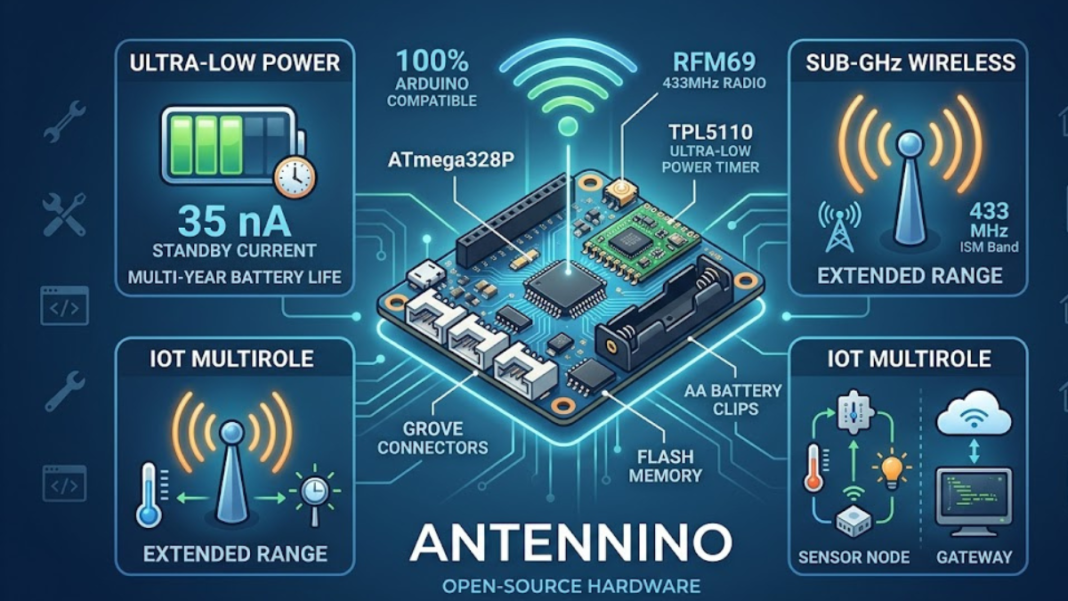

The Internet of Things (IoT) has completely changed how we interact with technology. From smart home sensors to automated industrial tracking, everything is becoming more connected. However, building long-lasting remote sensors always brings up a major roadblock: power consumption. Traditional microcontroller boards consume too much energy, draining batteries within days or weeks.
This is exactly where the antennino enters the picture. Designed specifically to tackle the challenges of remote wireless sensing, this multirole open-source hardware module combines processing power, built-in wireless communication, and advanced energy management.
also read: https://soutaipassu.com/tracqueur/
In this comprehensive guide, we will explore everything you need to know about the antennino, how it works, its technical specifications, and how you can use it to build highly efficient wireless networks.
What is an Antennino?
The antennino is a highly efficient, low-cost development board designed for wireless Internet of Things (IoT) projects. Its unique name is a creative portmanteau of Antenna and Arduino. Developed by Open Electronics, it serves as an excellent alternative to standard development platforms like the Arduino Uno, but with a massive advantage: integrated radio frequency (RF) capabilities and an extremely low standby power draw.
Unlike common Wi-Fi-based microcontrollers that consume significant bandwidth and battery power, this board communicates using sub-GHz radio frequencies. It is natively 100% compatible with the traditional Arduino IDE (Integrated Development Environment), allowing makers, engineers, and hobbyists to write code using familiar libraries.
A standout feature of the antennino is its multirole capability. Depending on how you configure the hardware and firmware, a single board can function either as a remote sensor node or as a centralized data collector, also known as a gateway.
Core Technical Specifications
To understand why this board is so effective for long-term deployments, we need to look under the hood. The creators carefully selected components that balance processing capability with aggressive power savings.
+-------------------------------------------------------------+
|                     ANTENNINO BOARD                         |
|                                                             |
|  [ Battery Clips ]      [ ATmega328P ]      [ RFM69 HW ]    |
|   AA / Rechargeable      Microcontroller     433 MHz Radio   |
|                                                             |
|  [ Flash Memory ]       [ Grove Ports ]     [ TPL5110 ]     |
|   512-Kbit Storage       I2C / Analog / IO   Deep Sleep Timer|
+-------------------------------------------------------------+
The Microcontroller: ATmega328P
At the center of the board sits the ATmega328P microcontroller. This is the exact same chip used in the legendary Arduino Uno, which guarantees broad software compatibility. However, the “P” in the name is critical—it stands for PicoPower technology. This silicon architecture allows the chip to shut down unused internal peripherals, significantly lowering energy consumption during sleep states.
Integrated Wireless: RFM69 Transceiver
Instead of power-hungry Wi-Fi or short-range Bluetooth, the board uses an onboard RFM69 transceiver module operating at the open 433 MHz frequency band. This frequency easily penetrates walls and covers long physical distances while drawing minimal current. The transceiver also supports hardware-based AES encryption to keep your wireless data secure from interception.
Expanded Storage and Sensors
The board includes a built-in 512-Kbit AT25F512B Flash memory chip. This serves two major purposes:
- Data Logging: It saves sensor readings locally when the gateway is temporarily out of range.
- Over-The-Air (OTA) Updates: It acts as a temporary storage area when downloading new firmware updates wirelessly.
Additionally, the base board comes equipped with a DS18B20 temperature sensor and a photoresistor for ambient light tracking right out of the box.
Detailed Hardware Breakdown
To make customization as straightforward as possible, the PCB (Printed Circuit Board) features a smart layout designed for expansion. Let’s look at the key physical attributes and connectivity options of the antennino.
Expansion and Connectivity via Grove Connectors
Soldering loose wires can lead to connection failures in field deployments. To prevent this, the board includes four integrated Grove connectors. These universal, plug-and-play interfaces let you quickly snap in external sensors and actuators without soldering.
| Connector Type | Primary Function | Common Use Cases |
| I2C Bus | High-speed synchronous data | Barometric pressure sensors, advanced displays |
| RS232 / UART | Serial communication | GPS modules, PC debugging interfaces |
| Analog Input | Reading variable voltages | Soil moisture probes, gas sensors |
| Generic I/O | Digital input and output | Relays, motion detectors, alarm switches |
Power Supply Versatility
The board offers three distinct power paths, giving you total flexibility depending on where and how your project is deployed:
- AA Battery Clips: The bottom of the PCB contains built-in clips for two standard 1.5V alkaline or 1.2V rechargeable AA batteries.
- External Voltage Input: An onboard voltage regulator accepts external DC power ranging from 3.6V up to 12V, making it fully compatible with small solar setups.
- Direct 3.3V Bypass: For maximum efficiency, you can inject a regulated 3.3V supply directly into the circuit, completely bypassing the internal regulators to eliminate idle power loss.
Achieving True Ultra-Low Power Consumption
Most standard microcontrollers suffer from a major design flaw when it comes to battery operation: their internal Watchdog Timers (WDT) keep the CPU partially active even during sleep mode. The antennino solves this issue by taking an entirely different approach to power management.
The TPL5110 External Timer Revolution
The true magic of the board lies in its integration of the Texas Instruments TPL5110 digital timer. Instead of letting the microcontroller handle its own sleep cycles, the TPL5110 acts as an external power switch.
When the microcontroller finishes reading its sensors and transmitting data, it sends a DONE signal to the TPL5110. The timer then completely cuts off all power to the microcontroller and the radio module. While in this standby state, the entire circuit draws a mere 35 nA (nanoamperes).
Once the pre-set interval ends (ranging anywhere from 100 milliseconds up to 2 hours), the TPL5110 powers the microcontroller back up to take the next reading. This approach extends the operating life of two standard AA batteries to multiple years.
+-----------------------------------------------------------------+
|                       POWER MANAGEMENT CYCLE                    |
|                                                                 |
|  +-------------------+      Wakes Up      +------------------+  |
|  |     TPL5110       | -----------------> |   ATmega328P     |  |
|  |  External Timer   |                    |  Microcontroller |  |
|  |  (Draws ~35 nA)   | <----------------- | (Reads & Sends)  |  |
|  +-------------------+     DONE Signal    +------------------+  |
+-----------------------------------------------------------------+
Automatic Transmission Control (ATC)
Radio transmissions are usually the most power-hungry phase of any wireless node’s operation. To address this, the board’s software stack utilizes Automatic Transmission Control (ATC) within the RFM69 library.
When a remote node communicates with the central gateway, it analyzes the signal strength. If the gateway is nearby, the node automatically lowers its transmission power to the minimum required level. If the node moves further away, it scales the power back up. This dynamic balancing prevents unnecessary battery drain during close-range communication.
Operating Modes: Remote Node vs. Gateway
Because the antennino is a multirole board, you can configure it to perform different functions across your wireless network architecture.
1. Remote Sensor / Actuator Node
In this mode, the board acts as an edge device. It spends the vast majority of its life in a deep sleep state via the TPL5110 timer. When awakened, it collects data from its connected Grove sensors, transmits a compact packet via the 433 MHz radio, waits for a brief acknowledgment, and immediately goes back to sleep. You can easily deploy these nodes as:
- Remote agricultural soil monitors
- Home security window and door sensors
- Vibration monitors for remote machinery
2. Central Data Collector (Gateway)
When configured as a gateway, the board stays permanently powered up via an external power supply or USB source. It listens continuously for incoming data packets from all surrounding remote nodes.
The gateway layout includes dedicated traces to mount a small OLED display. This allows you to check incoming data, view error logs, and track node statuses directly on the device without needing a computer connection. From the gateway, data can easily be forwarded to a PC, a local server, or an internet-connected dashboard.
Bootloader and Firmware Configuration
Getting started with the antennino requires uploading a bootloader to the ATmega328P chip. The bootloader is a small piece of permanent firmware that tells the chip how to manage startup operations and interface properly with the radio transceiver.
To flash the bootloader, you need an ICSP (In-Circuit Serial Programming) programmer set strictly to 3.3V. Using a standard 5V programmer will permanently damage the low-voltage RFM69 radio module and the memory chips.
Software utilities like BitBurner or the command-line tool AVRDUDE are commonly used to configure the chip’s internal fuse registers. These registers set the system clock source (such as the internal 8 MHz oscillator) and manage critical safety features like the hardware reset lines, ensuring the board boots reliably every single time.
Frequently Asked Questions
1. Can I program the board using standard Arduino Uno sketches?
Yes, you can write code using standard Arduino Uno sketches because they share the same ATmega328P microcontroller. However, you will need to add the RFM69 and TPL5110 libraries to your code to control the radio functions and deep sleep cycles.
2. What is the maximum open-air line-of-sight range for the 433 MHz radio?
In ideal conditions with a clear line of sight and a well-tuned antenna, the RFM69 module can reach transmission distances between 200 to 500 meters. Indoors, it easily cuts through multiple concrete walls and floors.
3. Does the board support Wi-Fi or Bluetooth out of the box?
No, it does not natively support Wi-Fi or Bluetooth. It is purposely designed around a 433 MHz radio to minimize power consumption and avoid crowded 2.4 GHz wireless bands.
4. Can I wake up the board before the scheduled TPL5110 timer interval ends?
Yes. The PCB breaks out a specialized interrupt pin called DELAY/M_DRV. If an external event occurs—such as a door sensor opening or an alarm triggering—it can pulse this pin to immediately wake the board up ahead of schedule.
5. What happens if the radio transmission fails? Does data get lost?
If you configure the board as a Data Logger, failed transmissions are caught by the code, and the sensor data is written directly to the onboard 512-Kbit Flash memory. The node can then retry sending the saved data once the gateway comes back online.
6. Is a license required to operate the radio frequency used by this board?
No, the 433 MHz frequency band is an ISM (Industrial, Scientific, and Medical) band that is completely free and open for public use in most countries without requiring an operator’s license.
7. How long will the board run on two standard alkaline AA batteries?
If configured to wake up once every 15 minutes to send data, the board can easily run for 2 to 3 years on a standard pair of AA batteries due to its ultra-low 35 nA standby current draw.
8. What is the purpose of the onboard photoresistor?
The photoresistor measures ambient light levels. This makes it incredibly easy to build automatic day/night triggers, solar tracking helpers, or basic outdoor lighting automated systems without adding external parts.
9. Can I connect 5V sensors directly to the Grove connectors?
No, the board runs entirely on a 3.3V logic level. Connecting a 5V sensor directly to the input pins can permanently damage the microcontroller. Always use a logic level shifter if you need to interface with 5V components.
10. Can multiple boards transmit data to the same gateway simultaneously?
Yes. The RFM69 library uses carrier-sense multiple access (CSMA) algorithms, meaning a node will listen to the channel and wait for it to be clear before transmitting. This prevents data collisions when multiple nodes try to talk at once.
Conclusion
The antennino provides a highly effective solution for long-term, battery-powered wireless sensing. By combining the accessibility of the Arduino ecosystem with the power of the sub-GHz RFM69 radio and the efficiency of the external TPL5110 timer, it eliminates the high energy drain common to standard IoT devices.
Whether you are looking to build a resilient smart home network, monitor an agricultural field, or create remote hardware actuators, this compact multirole board gives you the ideal foundation. It delivers years of reliable operation on simple AA batteries, making it a stellar choice for your next remote hardware deployment.